
Business
Bookkeeping Errors That Trigger HMRC VAT Return Queries

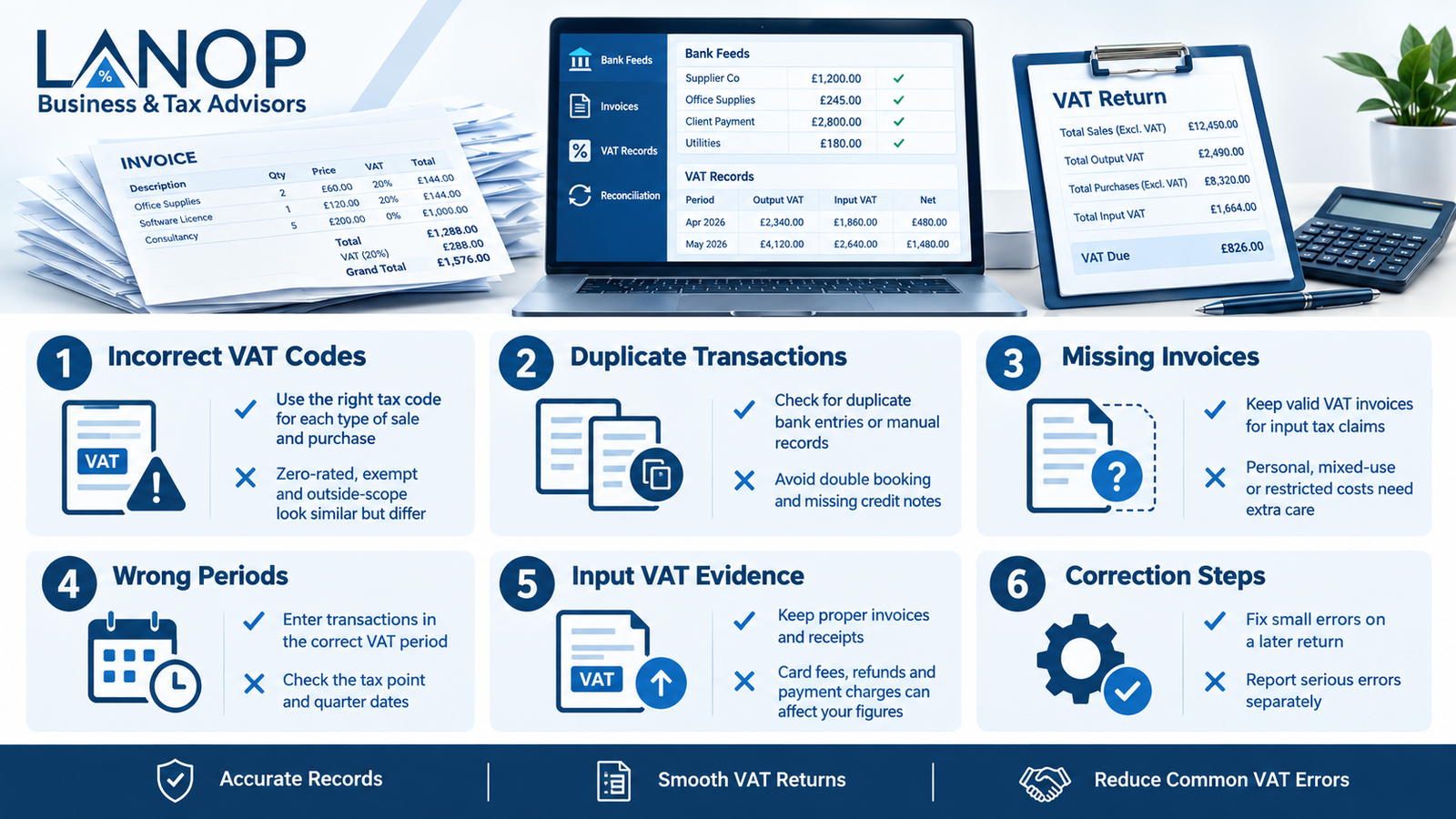
A café owner files her VAT return on the deadline and feels pretty good about it. Three weeks later, a letter from HMRC asks her to explain a sudden dip in sales. She hid nothing. A card payout got booked twice, and a refund never got booked at all. Good bookkeeping services catch slips like these before the return goes out.
An HMRC query doesn’t mean you did something wrong. Usually it means your figures and your records don’t agree. This guide covers the common mistakes, how to check your numbers, and what to do if you’ve already filed.
Which Bookkeeping Errors Can Trigger HMRC VAT Return Queries?
HMRC may ask questions when figures need clarifying or don’t match the records behind them. No single mistake guarantees a letter. These six cause the most trouble.
Incorrect VAT Rates and Tax Codes
Zero-rated, exempt and outside-the-scope sales look alike but behave differently. One wrong tax code in your software skews the return, even when every calculation is perfect.
Missing or Duplicate Transactions
Forget a credit note and your sales look inflated. Record a sale by hand and again through the bank feed, and you’ve doubled it. Either way, your totals drift away from reality.
Input VAT Without Proper Evidence
A receipt alone doesn’t always give you the right to reclaim VAT. You generally need a valid VAT invoice. Personal, mixed-use and restricted expenses need extra care.
Transactions in the Wrong VAT Period
Enter a sale in the wrong quarter, or misjudge the tax point, and the return stops matching the records underneath it.
Refunds, Credit Notes and Payment Fees
Card processors and online marketplaces pay you net of their fees. Book only the payout and you understate sales. Skip the fees and your costs look off too.
Reverse Charge, Imports and Special Schemes
Reverse-charge purchases, import VAT, the Flat Rate Scheme and partial exemption all carry their own rules. Errors here are rarely small. Get specialist advice before you file.
Why Do Bookkeeping Errors Create Problems With HMRC?
Because messy records make a return hard to verify. Questions can follow when you have:
- Figures that don’t match invoices or your VAT control account
- Input VAT claims you can’t support
- Unexplained swings in sales, VAT payable or refunds
- Repeated discrepancies nobody resolved
- Missing records that leave you unable to show your workings
These are possible reasons for a closer look. They aren’t a list of HMRC’s detection rules, and nobody outside HMRC knows those.
How to Check Your Bookkeeping Before Submitting a VAT Return?
A 30-minute review beats a three-month correspondence. Match sales and purchases to invoices and credit notes. Question unusual or high-value tax codes. Reconcile your books against bank and payment-platform reports, and investigate any gap in the VAT control account.
A matching bank balance doesn’t prove the return is right. Wrong VAT codes can hide behind correct totals.
Before you submit, tick off this list:
- Every sale, purchase and credit note is recorded once
- Unusual transactions have the right VAT treatment
- Bank and VAT control accounts reconcile
- Input VAT claims have valid invoices
- The return agrees with your accounting reports
- You’ve noted any corrections you made
What Should You Do If HMRC Queries Your VAT Return?
Stay calm. A request for information isn’t an accusation of fraud.
Understand What HMRC Is Asking For
Read the letter twice. Note the return period, the figures under review, the documents requested and the deadline.
Gather Your Records and Find the Difference
Pull the invoices, statements and reports for that period, then reconcile them against the return. Write down what you find and any fix you make.
Respond on Time
Answer the questions asked and attach the relevant records. If the figures won’t reconcile, bring in a professional early.
How Can You Correct an Error on a VAT Return Already Submitted?
The right route depends on the size and nature of the mistake.
When Can You Fix It on a Later Return?
Some errors can go through your next VAT return if they meet HMRC’s conditions. Not every mistake qualifies.
When Must You Report It Separately?
This also applies for cases when the errors are so serious, and when there are deliberate inaccuracies which need to be separately reported to HMRC. Always make sure that you comply with HMRC’s guidelines concerning when and how to declare VAT mistakes (VAT Notice 700/46) as there may be updates to limit ranges and procedures.
What Should You Record?
Note the affected period, the amount and the reason. Keep your calculations and supporting documents. Together they form an audit trail that shows what changed and why.
What If You Discover VAT Errors From Previous Years?
Don’t ignore it. Work through it in order:
- Identify which VAT periods the error could touch.
- Rebuild missing records from invoices, bank statements and accounting data.
- Estimate the value of each error and trace its source.
- Choose the correction route under HMRC’s current rules.
- Document everything you did.
Material, repeated or hard-to-quantify errors usually justify professional help.
Can Accounting Software Prevent VAT Return Errors?
It helps a lot, but it won’t help you. Software imports bank transactions, matches payments, applies tax codes and produces VAT reports.
It can’t tell that a supplier invoice is missing. Nor will it notice that a laptop purchase imported cleanly with the wrong VAT code. The return looks tidy and says the wrong thing.
Automation saves time. Human review keeps the return accurate.
How Often Should a Business Review Its VAT Records?
Processing records what happened. Reconciliation proves the records are right. They’re different jobs.
Weekly checks suit busy firms with high volumes or several payment channels. Monthly reviews often work for smaller businesses. Regular checks catch problems sooner, though they can’t catch everything.
How Bookkeeping Services Can Help Reduce VAT Errors?
Dull bookkeeping work that guards against losses and increases return is best done consistently.
This work includes recording and categorizing the same way each time. You will not only balance your accounts properly and be able to easily spot unusual entries, but you will also find that you can prevent problems by correcting what causes recurring mistakes.
By doing consistent bookkeeping you have trustworthy records which can be used when submitting papers and if HMRC raises the issue of a particular item to do with your books.
Lanop bookkeeping services can be a great help to you during the bookkeeping work. Although no provider is going to say that you will not be subject to any questions, you will find any inquiries far easier to answer if your books are in order.
Frequently Asked Questions
What type of bookkeeping errors lead to an HMRC VAT query?
Using incorrect VAT rates, absence or duplication of records, claims of input VAT without proper documents, and discrepancies between the records and the return may cause your VAT to be queried by HMRC.
Is an HMRC VAT query the same as my business being subject to a more thorough investigation?
No, not necessarily. One difference is that while the first will be a request for information the second is called a wider compliance check. However, your main duty is to comply with the written instructions of the letter you receive.
What is the result of claiming VAT for a purchase without an invoice from the supplier?
You may end up claiming VAT in error if you do not have a valid invoice at that time. Whether you will lose the claim or not is a matter of circumstances, so you should get professional advice first.
Is it possible to correct a VAT return after I have already filed it?
In most cases, yes. Depending on the nature of the mistake and conditions imposed by HMRC, different ways of remedying errors may be available.
Will using a professional bookkeeper help in reducing my VAT errors?
Through accurate recording, reconciliation and review a good bookkeeper could minimize unintentional VAT error occurrences. However, they can’t be held responsible for getting rid of every error.
Conclusion
Many of the problems with VAT tax only happen a little bit at the start of your tax period, for example the choice of an incorrect tax code, the omission of a credit note, or paying one transaction twice. It’s the kind of errors which you can fix if only you do not delay. Keep your supporting documents with you, and only when something happens which you have not corrected properly and it is discovered afterwards then you follow HM’s correction procedure.
To a large extent, the bookkeeping you do will determine how easy managing VAT will be. If there is a letter from the HMRC, you will be able to deal with it without too much worry if your business records were properly kept.
In case of problems with your records, Lanop Business and Tax Advisors can double-check your documents so that HMRC does not have to.


Bookkeeping Errors That Trigger HMRC VAT Return Queries
Hiring Your First Employee: A Payroll Checklist for UK Small Businesses

Sorting Out Theboringmagazine Com From Its Lookalike Domains

Who Is William Lancelot Bowles Jr.? The Intriguing Untold Tale of Phylicia Rashad’s Ex-Husband

Who Is Chanelle Haynes? The Fascinating True Story of Cornell Haynes III’s Sister

The Inspiring Story of Kelly Davis Rucker: From Struggle to Success
-
 Celebrity4 months ago
Who Is William Lancelot Bowles Jr.? The Intriguing Untold Tale of Phylicia Rashad’s Ex-Husband
-
 Celebrity4 months ago
Who Is Chanelle Haynes? The Fascinating True Story of Cornell Haynes III’s Sister
-
 Celebrity4 months ago
The Inspiring Story of Kelly Davis Rucker: From Struggle to Success
-

 Technology2 months ago
Voozon.com Review: Is It Legit? Features, Benefits, and What to Know
-

 Celebrity2 months ago
Who Is Dallas Yocum? The Fascinating Life Story of Mike Lindell’s Ex-Wife
-

 Celebrity2 months ago
Who Is Noah Wilde West? Everything to Know About Chyler Leigh’s Son
-

 Blog2 months ago
Who Is Cassandra Jade Estevez? The Captivating Life Behind Casey Huffman Wife
-

 Business2 months ago
UploadArticle.com Review: Is It the Best Free Platform to Upload Articles?