
AI
Anthropic’s 1-Hour Cache: One Line That Changes Your Bill, Not Your Model

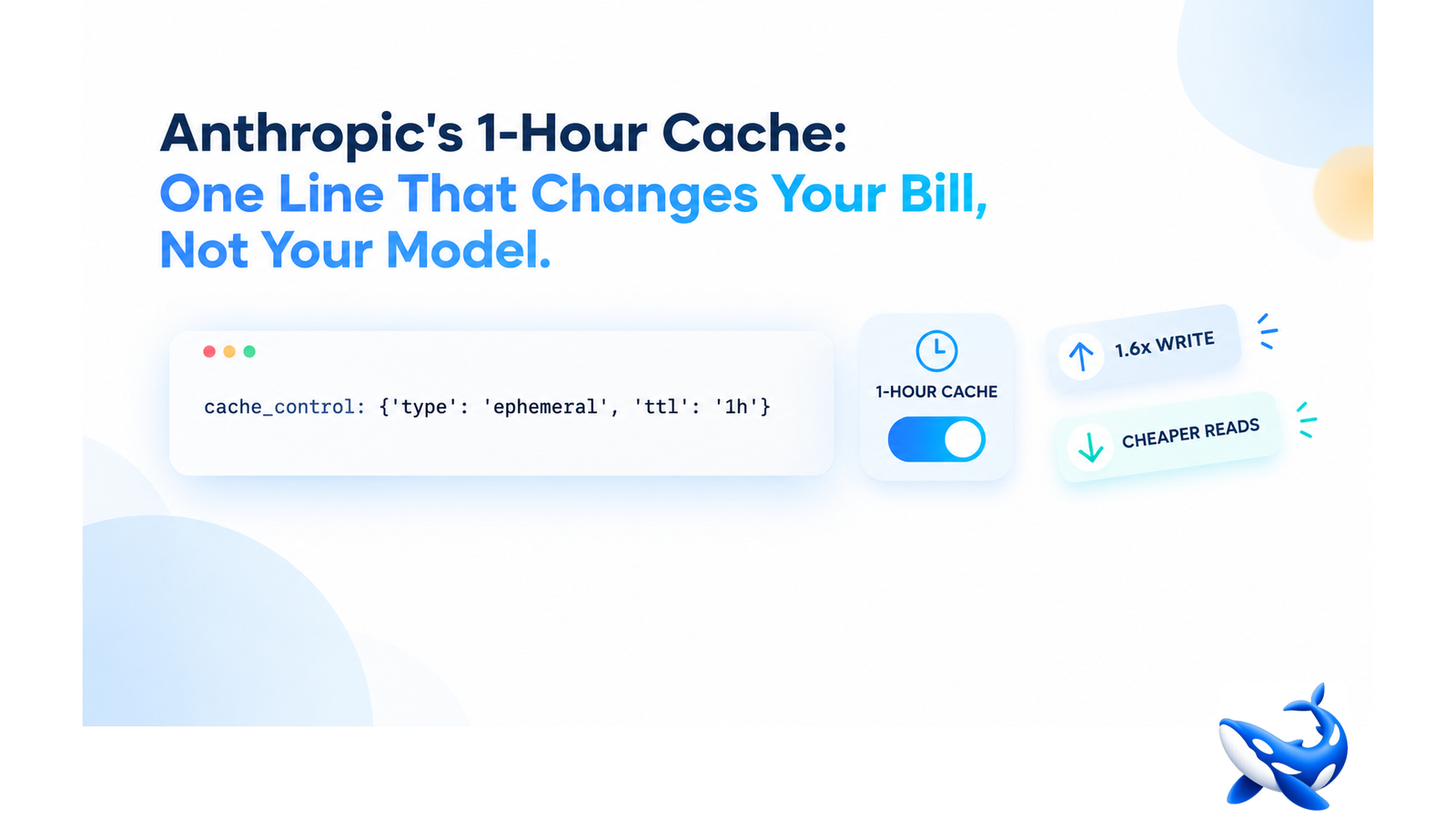
One configuration line is all it takes, and it changes the arithmetic of your bill rather than the model answering your prompts. On OrcaRouter the anthropic models provider page routes the Anthropic catalogue, and the gateway’s pricing page explains the cache option in one sentence: “Anthropic’s 1-hour cache writes bill at 1.6x the 5-minute rate shown.” The same page’s worked example — Anthropic: Claude Opus 4.8, $5.00 input, $0.500 cached input, $6.25 per 5-minute cache write, $25.00 output — spells out the whole scheme in a single row [VENDOR]. Anthropic’s own model pages confirm that the tier exists, from Claude Fable 5.1 at $10.00 / $50.00 to Claude Opus 5.5 at $4.00 / $20.00 [VENDOR].
The one line is a billing switch, not a performance switch. It does not make the model faster or smarter. It decides whether the repeated prefix of your conversation is billed at the cache rate — and at what surcharge the write that creates it is billed. Whether that line saves you money is a pure question of how long your agent waits between turns.
The 1.6x write, and the 60% premium on short intervals
Cache pricing has two sides: what it costs to write a cache entry, and what it costs to read it back. Anthropic’s 1-hour cache changes the first of those. The pricing page states that writes billed under the 1-hour window run at 1.6x the 5-minute rate shown [VENDOR]. In the worked example, a 5-minute cache write for Claude Opus 4.8 is $6.25 per million tokens; the 1-hour variant is that figure times 1.6 [VENDOR]. The reading side, meanwhile, gets cheaper the longer the cache lasts, because a prefix cached for an hour survives conversations a five-minute cache would have had to write again.
That 1.6x is the whole catch. A cache entry that costs 60% more to write pays for itself only if the reads it serves, at the discounted cache rate, outnumber and outweigh the extra write cost. For an agent that turns over its context every few minutes, the 1-hour window is mostly a more expensive way to do what the 5-minute window already did.
The same prefix rewritten is the hidden cost
What actually decides the outcome is how often your conversation rewrites its own prefix. A five-minute cache expires in five minutes, so any turn that comes later than that starts a fresh, full-price write. A one-hour cache holds the prefix across far more turns — but every cache write it performs is billed at 1.6x, and with a long-lived window the writes keep coming at the higher rate for the entire session. The arithmetic only favours the 1-hour line when the session’s average interval between calls is longer than five minutes, so the cheaper reads have room to accumulate against the surcharged writes.
For session intervals under five minutes the verdict is harsh. Every write is 60% more expensive than the 5-minute alternative, and the cheaper read never arrives to offset it, because the 5-minute window would have billed those reads just the same. A sub-five-minute agent on the 1-hour line is paying 60% more per write for no reading-side benefit at all — a pure loss, repeatable on every session that rewrites its prefix.
The asymmetry is what makes this easy to get wrong in one direction and hard to get wrong in the other. Choosing the 5-minute window on a long-interval workload costs you the cache hits you could have kept, and the bill rises gently. Choosing the 1-hour window on a short-interval workload costs you 60% on every write, and the bill rises sharply. One mistake is a missed optimisation; the other is a surcharge you opted into. That is the argument for measuring the interval first and treating the longer window as the deliberate choice rather than the default one.

What the model pages actually offer
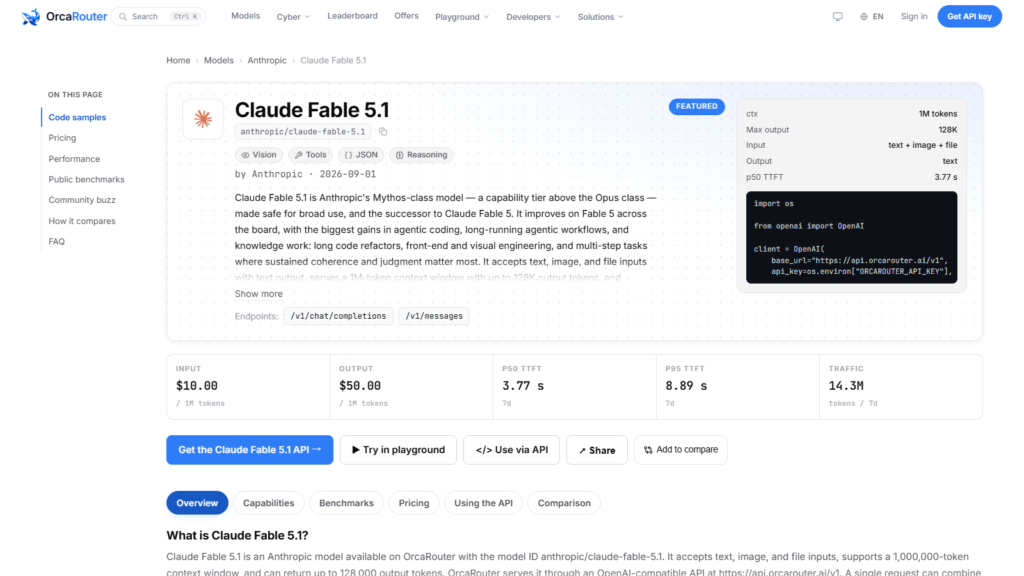
Anthropic’s model pages on the gateway confirm the tier exists per model. Claude Opus 5.5 is listed at $4.00 per million input tokens and $20.00 per million output, and its page notes the model is offered “including a 1-hour cache option” [VENDOR]. Claude Fable 5.1 sits above it at $10.00 / $50.00, and its page carries the same 1-hour cache option [VENDOR]. The choice is therefore not whether to use Anthropic caching — the 5-minute window exists on the same gateway — but which expiry to put in the configuration line.
The line, and the arithmetic you run before writing it
The configuration line itself is unremarkable; it is the decision around it that is worth making deliberately. Before you add the 1-hour cache line to an agent, you can measure one number: the interval between your session’s calls. If turns come less than five minutes apart on average, keep the 5-minute window, because the 1-hour variant charges 60% more per write and your sessions never let the longer cache pay for itself. If turns routinely stretch past five minutes — an agent polling for a long-running job, a review that sits open while a human reads — the 1-hour window turns an expired-and-rewritten prefix into a surviving one, and the cheaper reads finally outweigh the surcharged writes.
Two details are worth checking before you write the line, because both change the arithmetic. The first is what your agent actually re-sends. Caching pays on the prefix that repeats; a session that rebuilds its context from scratch on every turn has nothing stable to cache, and changing the expiry will not help it. The second is whether the interval is an average or a distribution. An agent with a long median gap and a burst of fast follow-up turns gets the surcharged writes on the burst and the surviving cache on the gaps, and the net depends on which of the two carries more tokens. Neither detail is visible from the pricing page; both are visible in a request log that records per-call token counts and cache hits.
The takeaway
The 1-hour cache is one configuration line, and it changes the billing arithmetic, not the model. The write that creates a 1-hour cache entry bills at 1.6x the 5-minute rate shown, against cheaper reads that last an hour [VENDOR]. The line saves money only when your agent’s session intervals are longer than five minutes, giving the cheaper reads room to outweigh the 60% write surcharge; below that interval it is a pure loss, because every write costs more and the reads were never going to be billed cheaper anyway. Anthropic’s model pages on the gateway confirm the tier exists on Claude Opus 5.5 and Claude Fable 5.1 [VENDOR]. The decision is not which model the line selects — it selects no model at all. The decision is whether your session’s rhythm earns the 60% write premium. Measure the interval, then flip the switch.
Sourcing note: the 1.6x cache-write statement, the Claude Opus 4.8 pricing example, the per-model prices and the 1-hour cache option on both model pages are the vendor’s own published figures as reproduced on the pricing and model pages [VENDOR]. The 1.6x-to-60% conversion and the break-even reasoning about session intervals are our own arithmetic and analysis [OURS]. No third-party benchmark figures are used. Telemetry figures are rolling and will drift. Read 2026-10-15.


SCADA Cybersecurity Best Practices for Industrial Facilities

What Glaadvoice Com Really Is and Who Stands Behind It

What Sparkpressfusion Com Shows About Its Own Team and Claims

Who Is William Lancelot Bowles Jr.? The Intriguing Untold Tale of Phylicia Rashad’s Ex-Husband

Who Is Chanelle Haynes? The Fascinating True Story of Cornell Haynes III’s Sister

The Inspiring Story of Kelly Davis Rucker: From Struggle to Success
-
 Celebrity4 months ago
Who Is William Lancelot Bowles Jr.? The Intriguing Untold Tale of Phylicia Rashad’s Ex-Husband
-
 Celebrity4 months ago
Who Is Chanelle Haynes? The Fascinating True Story of Cornell Haynes III’s Sister
-
 Celebrity4 months ago
The Inspiring Story of Kelly Davis Rucker: From Struggle to Success
-

 Technology2 months ago
Voozon.com Review: Is It Legit? Features, Benefits, and What to Know
-

 Celebrity2 months ago
Who Is Dallas Yocum? The Fascinating Life Story of Mike Lindell’s Ex-Wife
-

 Celebrity2 months ago
Who Is Noah Wilde West? Everything to Know About Chyler Leigh’s Son
-

 Business2 months ago
UploadArticle.com Review: Is It the Best Free Platform to Upload Articles?
-

 Blog2 months ago
Who Is Cassandra Jade Estevez? The Captivating Life Behind Casey Huffman Wife