
Business
The New Business Software Stack: ERP, APIs & AI Agents

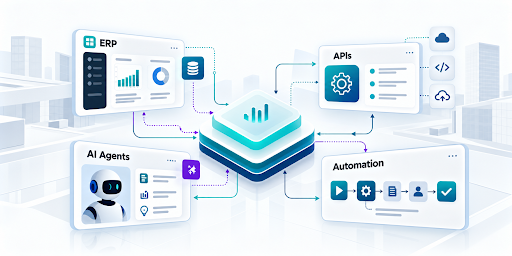
Business software is moving beyond standalone tools. ERP systems still manage core operations, but APIs now connect different applications, AI agents can interpret business information and support decisions, and automation can turn those decisions into action.
Together, these technologies are creating a new business software stack that is more connected and intelligent than traditional enterprise software setups. For businesses exploring this shift, an AI agent development company for enterprise can help build AI capabilities that work alongside existing systems rather than functioning as isolated tools.
The important question is no longer which single software a business should adopt. It is how ERP, APIs, AI agents, and automation can work together to create a more responsive and efficient operating environment.
What is a Business Software Stack?
A business software stack is the collection of applications, systems, integrations, and technologies a company uses to run its day-to-day operations. Instead of relying on one platform for everything, businesses typically combine ERP, CRM, finance, communication, analytics, and other specialized tools.
The difference today is that these systems no longer have to operate independently. APIs can connect them, automation can move information and trigger actions between them, and AI can add intelligence to workflows that previously depended entirely on manual decisions.
A modern business software stack can therefore be viewed as several connected layers:
- ERP: Manages core operational and business data.
- APIs: Connect different applications and allow them to exchange information.
- AI agents: Interpret data, reason through tasks, and support or initiate decisions.
- Automation: Executes repetitive actions and coordinates workflows across systems.
The value comes from how these layers work together. A business does not simply gain another set of tools; it creates a connected operating environment where information can move more easily and processes can become increasingly intelligent.
ERP: The System of Record
ERP remains the foundation of the business software stack because it brings core operational data into one environment. Finance, inventory, procurement, sales, manufacturing, and other functions can work from shared information instead of maintaining separate records across disconnected tools.
But the role of ERP is changing. Businesses increasingly expect their ERP to connect with e-commerce platforms, CRM systems, payment services, logistics tools, analytics platforms, and newer AI capabilities. This makes integration and implementation decisions just as important as the ERP features themselves.
For companies adopting an ERP as part of a broader technology ecosystem, choosing the right Odoo ERP implementation company can help ensure that the system is configured around actual business processes and prepared to integrate with the applications and workflows surrounding it.
A well-implemented ERP therefore does more than centralize information. It provides the reliable operational data that the rest of the modern business software stack can build on.
APIs: The Connectivity Layer
An ERP can centralize business information, but modern operations rarely happen inside one system. A customer order might begin on an e-commerce platform, move into an ERP, trigger a payment process, and then reach a logistics system. APIs make these connections possible by allowing different applications to exchange data and communicate with one another.
This connectivity helps businesses reduce data silos and avoid repetitive manual transfers. Instead of employees downloading information from one application and entering it into another, systems can exchange relevant data automatically.
APIs also provide the foundation for more intelligent workflows. An AI agent cannot make useful decisions if it cannot access the business information it needs. By connecting ERP, CRM, inventory, finance, and other applications, APIs give AI and automation layers access to the operational context behind a task.
In this sense, APIs are more than a technical integration method. They are the connective layer that allows the different components of a modern business software stack to function as one ecosystem.
AI Agents: The Intelligence Layer
Traditional automation usually follows predefined rules: when one event occurs, a specific action is triggered. AI agents introduce a different approach. They can interpret information, consider context, determine what needs to happen next, and in some cases take action through connected business systems.
For example, an AI agent could review inventory levels, recent sales, supplier information, and expected demand before recommending whether a purchase should be initiated. Instead of simply responding to a predefined condition, the agent can work with multiple sources of information to support a more contextual decision.
This makes enterprise AI more dependent on the systems surrounding it. An agent needs reliable business data, access to relevant applications, appropriate permissions, and APIs through which it can interact with those systems. Without that foundation, even a capable AI model has limited value in real operational workflows.
For businesses adopting this approach, an AI agent development company needs to consider more than the AI model itself. The real challenge is connecting intelligence to business processes in a controlled, secure, and useful way.
AI agents therefore become the intelligence layer of the modern business software stack, sitting between business information and the actions that need to happen next.
Automation: Turning Decisions Into Actions
AI can help determine what should happen next, but a decision still needs to become an action. This is where workflow automation connects intelligence with execution.
Automation can handle tasks such as creating records, sending notifications, updating inventory, requesting approvals, synchronizing data, or triggering follow-up processes across different applications. Instead of requiring employees to manually move information from one system to another, predefined workflows can handle these steps consistently.
A Simple Example: From Inventory Alert to Purchase Order
Consider a manufacturer whose inventory for a critical component is falling faster than expected. The ERP records current stock levels and recent order activity. An API makes that information available to an AI agent, which can also consider historical demand, open customer orders, supplier lead times, and other relevant data.
The agent can then determine that additional stock may be required and recommend a purchase. Once the appropriate conditions or approval are met, an automated workflow can create a purchase request, notify the procurement team, update the relevant records, and trigger the next steps without someone manually transferring information between systems.
The important point is that no single technology is responsible for the entire process. The ERP provides the operational data, APIs move that information, the AI agent adds context and intelligence, and automation executes the resulting workflow.
Businesses looking to connect these processes may work with an n8n workflow automation company to orchestrate workflows across multiple applications while keeping existing systems at the center of their operations.
The result is a clear division of responsibilities: AI can provide intelligence, while automation makes sure the required business actions actually happen.
How the Four Layers Work Together?
The real value of the new business software stack appears when ERP, APIs, AI agents, and automation operate as one connected workflow. Each layer has a different role, but the output of one becomes the input for another.
A typical process might look like this:
ERP → API → AI Agent → Automation → Business Action
For example, an ERP may detect that inventory for a product is approaching a critical level. An API can make the relevant inventory, sales, and supplier data available to an AI agent. The agent can evaluate current demand, outstanding orders, and supplier lead times before determining whether replenishment is necessary.
Once the decision meets the required business rules or receives approval, automation can create the purchase request, notify the procurement team, update connected systems, and initiate the next workflow.
This model changes how businesses think about software integration. The goal is not simply to connect more applications. It is to create a flow where data is available, intelligence can interpret it, and workflows can turn decisions into measurable actions.
That is what makes the modern business software stack more than a collection of tools. It becomes a connected operating layer that can respond to business events with less manual intervention.
What Businesses Should Consider Before Building the New Stack
Building a connected software stack is not simply a matter of adding more tools. Businesses need to determine which processes need improvement, what information those processes depend on, and where technology can create measurable value.
A practical way to approach this is to evaluate the stack through five questions:
1. What is the business problem?
Start with the workflow, not the technology. Identify where employees spend excessive time, where information gets stuck, or where decisions are repeatedly delayed.
2. Where does the data live?
Map the systems involved in the process. Determine whether the required information sits in an ERP, CRM, database, spreadsheet, e-commerce platform, or another application. Poor or fragmented data can undermine everything built on top of it.
3. Does the process need rules or reasoning?
Straightforward, predictable tasks may be better suited to traditional automation. Processes involving changing information, context, or multiple variables may benefit from AI assistance or an AI agent.
4. How will the systems communicate?
Identify the APIs and integrations required to move information between applications. A workflow is only as reliable as the connections supporting it.
5. What happens after a decision is made?
Define the execution layer. Determine which actions should happen automatically, which require approval, and which should remain with employees.
This framework can be summarized as:
Business problem → Data → Decision → Integration → Action
Security, permissions, monitoring, scalability, and human oversight should then be considered across every stage.
This approach helps businesses avoid adopting technology simply because it is new. Instead, ERP, APIs, AI agents, and automation each have a defined role within a business process and can be evaluated according to the outcome they are expected to produce.
Where the Business Software Stack is Heading
The business software stack is moving toward greater connectivity and more intelligent execution. ERP systems are becoming more closely integrated with AI capabilities, while APIs make it easier to connect specialized applications without replacing the systems businesses already rely on.
AI agents are also likely to take on more operational roles. Instead of simply answering questions, they can increasingly work with business data, interpret context, coordinate tasks, and interact with connected applications. This could make routine workflows more adaptive while keeping people involved in decisions that require judgment or accountability.
At the same time, automation is moving beyond isolated tasks toward end-to-end workflow orchestration. A single business event may eventually trigger a sequence involving data retrieval, AI analysis, approval, system updates, and communication across multiple applications.
For businesses, the takeaway is practical: the goal should not be to adopt every new technology, but to build a software environment where each technology solves a specific operational problem. Companies with a reliable ERP, accessible data, well-designed integrations, and carefully selected automation can add AI capabilities incrementally instead of rebuilding their entire technology environment.
The competitive advantage may therefore come less from owning the newest software and more from how effectively a business connects the software it already has. A well-designed stack can reduce manual work, improve access to operational information, accelerate decisions, and create workflows that can adapt as the business grows.
End Note
The modern business software stack is becoming less about individual applications and more about how those applications work together. ERP provides the operational foundation, APIs connect systems and data, AI agents add intelligence, and automation turns decisions into actions.
Businesses do not need to replace everything they already use to adopt this model. A more practical approach is to identify high-value processes, strengthen the underlying data and integrations, and introduce AI or automation where it can deliver a measurable improvement.
As these technologies become increasingly connected, businesses may also need the right implementation expertise to bring them together effectively. Working with an n8n workflow automation company can help organizations connect applications and automate multi-step processes while building on their existing technology investments.
Ultimately, the new business software stack is not about adding more software. It is about creating a connected operating environment where information flows efficiently, decisions have better context, and business processes can move from manual execution toward intelligent automation.


Who Is Elease Johnson? The Amazing Life Story of Bumpy Johnson’s Daughter

Improving Construction Budget Accuracy Through Professional Estimating and Lumber Takeoffs in California

Who Is Paige Fertitta? The Amazing Life Story of Tilman Fertitta’s Ex-Wife

The Inspiring Story of Kelly Davis Rucker: From Struggle to Success

Voozon.com Review: Is It Legit? Features, Benefits, and What to Know

Who Is William Lancelot Bowles Jr.? The Intriguing Untold Tale of Phylicia Rashad’s Ex-Husband
-
 Celebrity3 months ago
The Inspiring Story of Kelly Davis Rucker: From Struggle to Success
-
 Technology1 month ago
Voozon.com Review: Is It Legit? Features, Benefits, and What to Know
-
 Celebrity3 months ago
Who Is William Lancelot Bowles Jr.? The Intriguing Untold Tale of Phylicia Rashad’s Ex-Husband
-

 Celebrity3 months ago
Who Is Chanelle Haynes? The Fascinating True Story of Cornell Haynes III’s Sister
-

 Business1 month ago
UploadArticle.com Review: Is It the Best Free Platform to Upload Articles?
-

 Celebrity3 months ago
Who Is Iona McKidd? The Hidden Brilliance of Kevin McKidd’s Daughter
-

 Blog1 month ago
Who Is Cassandra Jade Estevez? The Captivating Life Behind Casey Huffman Wife
-

 Celebrity3 months ago
Who Is Ella Sofia Gordon? The Incredible Story Behind Jeff Gordon’s Daughter